- Distance travelled per well
- Speed and active time per larva
- Light and dark periods defined in the protocol
- Treatment-group reports with exportable charts
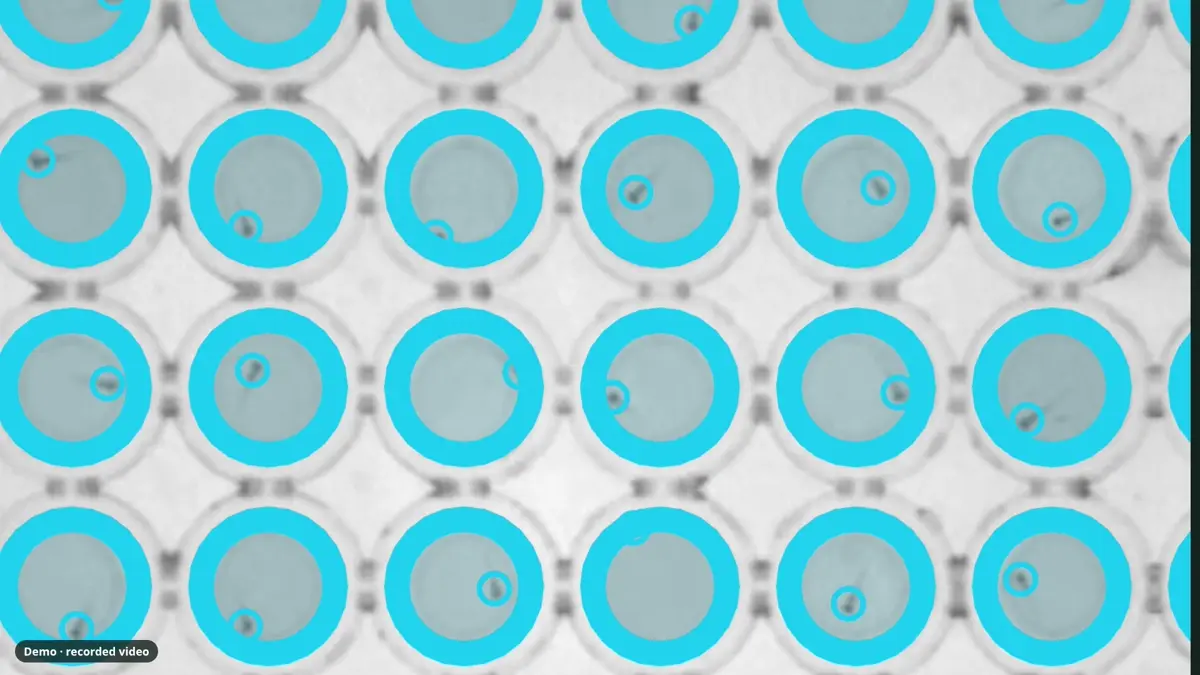
- The track of each well and the video of the test, to check before you export
- Every test sealed when it ends, with a record of who changed what
- A dataset export ready for your statistics software
- Included in the Research plan, with rodents on the same station
Zebrafish video tracking
Every larva in every well,
measured as the test runs.
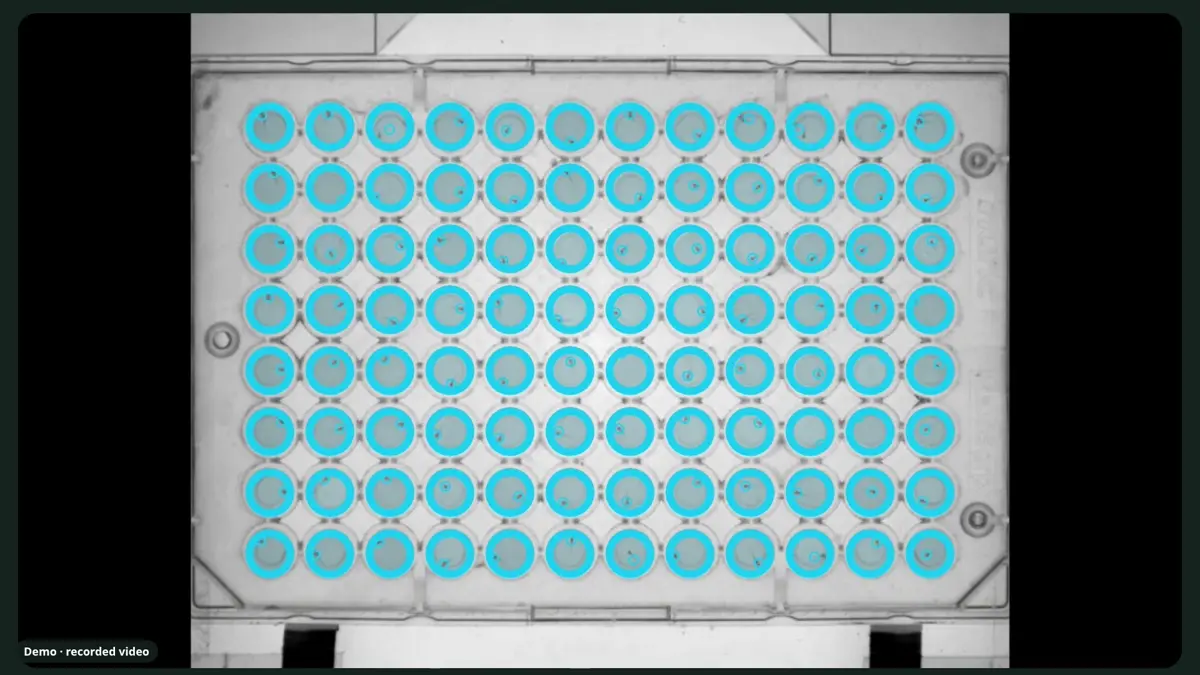
Show the station your multi-well plate: each well gets its own zone in seconds. Each larva is followed in its well for the whole test, and distance, speed and activity per well are compared by treatment the moment you press Stop. No scoring by hand, no plate scored twice.
Forty seconds, one plate
A 96-well plate, from the plate to the report.
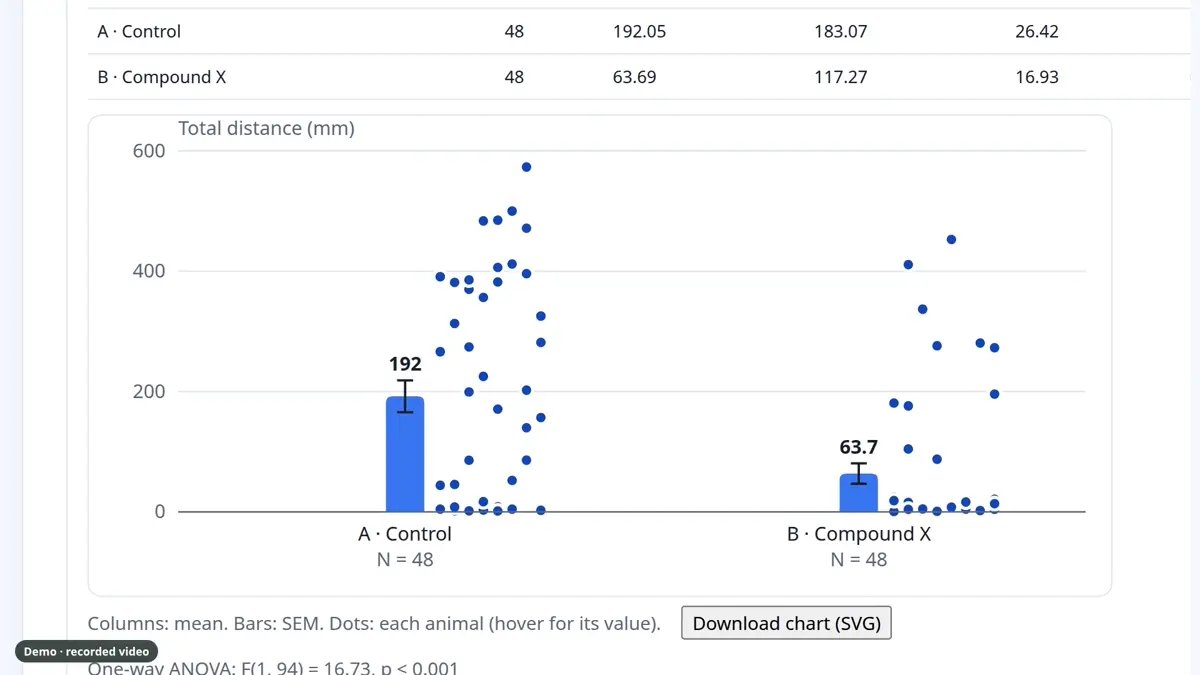
The wells are found on the image, every larva is followed in its own well, and the report compares your treatments when the test ends.
What you get after every plate
Results the moment the test ends
Distance, speed and activity for every well, ready as soon as the test stops, so you can decide on the next plate straight away.
A whole plate on one camera
One larva per well, all wells followed at once, with the same zones for every plate of the study.
Rodent and zebrafish teams, one workspace
Colleagues open the same experiments and results from their own computer. Nothing to install, nothing to copy.
The plate, the larvae, the report
Built for the assays you run
Compound screening
Assign wells to treatments, run the plate, and read the effect on locomotion group by group as soon as the test ends.
Toxicology and safety
Activity recorded the same way on every plate, every test sealed, every result traced to the settings that produced it.
Neurobehavioral phenotyping
Compare lines and conditions on the same plate layout, and pool plates from several stations into one study.
A typical session
Wells and treatments
Assign the wells of the plate to your treatment groups in a grid, or import them from your file.
The plate on the image
The station finds the wells on the picture of your plate; the layout is kept for every plate of the study.
Start, test, next plate
Press Start; the test runs for the duration of your protocol and stops by itself.
Report and export
Groups compared on a chart, an exportable dataset for your statistics, and the archive of every test, sealed.
Common questions
Which zebrafish tests does it support?
Locomotion and activity of larvae in multi-well plates: baseline activity, response to a compound, light and dark periods you define in the protocol. Tell us your assay and we will say what we measure.
How many larvae per test?
One larva per well, every well of the plate followed at once on one camera, up to a 96-well plate.
Do we need a dedicated chamber?
No. The station and its camera arrive ready to use, on rental with your plan; you bring your plate and your larvae. We advise on the backlight and the placement during the demo.
Can I compare treatment groups?
Yes. Assign the wells to your treatments and the report compares the groups with mean and standard error, each larva a dot, the chart exportable.
Can several people use the same experiment?
Yes. Your rodent and zebrafish colleagues work in one shared workspace, each from their own computer.
Can we check a result before we export it?
Yes. The track of each well and the video of the test are kept, so you can look at any larva before the export.
Can we try it before subscribing?
Yes. Request your free demo to run a simulated plate in your browser, then try the complete setup in your lab for 15 days.
Keep exploring
Request your free demo and run a simulated plate in minutes.